

After a collision, each driver may give a different account of what happened. One may say the other was speeding, while the other claims a sudden lane change caused the crash. Insurance companies, attorneys, and courts rely on evidence showing how the collision occurred and whether a driver failed to act with reasonable care. People facing disputed liability may benefit from speaking with a local accident attorney in Slidell who can assess the evidence and explain their options.
Determining how fault is proven after a car accident requires examining physical evidence, witness testimony, vehicle damage, police documentation, traffic laws, and medical records together. A claim often depends on whether those sources support the same sequence of events.
Fault can affect insurance coverage, compensation, and whether an injured person may recover damages. A dispute may also strain a family’s income, transportation, and financial stability.
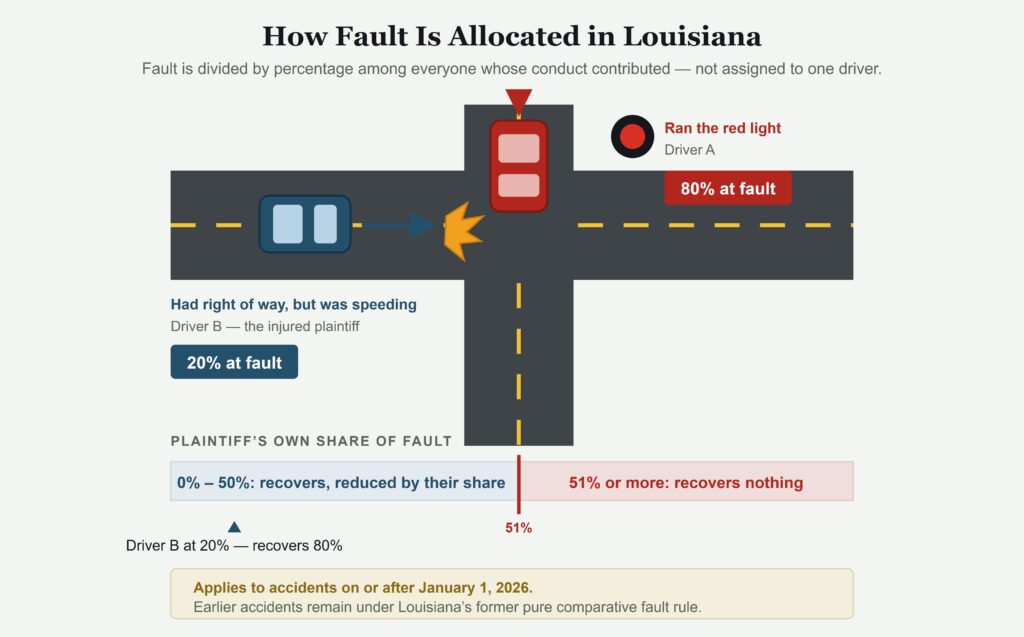
In Louisiana, responsibility may be divided among everyone whose conduct caused or contributed to a crash. For accidents occurring on or after January 1, 2026, an injured person assigned 51% or more of the fault generally cannot recover damages; below that threshold, any recovery is reduced by that person’s percentage of fault. One exception applies: under Louisiana Civil Code article 2323(C), a claimant’s recovery is not reduced when the claimant’s negligence is compared with the fault of a person who acted intentionally. Accidents occurring before January 1, 2026 generally remain governed by Louisiana’s former pure comparative fault rule, under which a plaintiff’s recovery was reduced by their share of fault without a percentage bar. Because the date of the accident controls which rule applies, it should be confirmed early.
What Fault Means in a Car Accident Case
Fault is the legal responsibility assigned to a person whose conduct caused or contributed to an accident. In most cases, proving fault involves showing that a driver acted negligently.
In Louisiana, negligence is commonly evaluated under a duty-risk analysis. An injured person generally must show that:
- The driver owed a duty to act reasonably under the circumstances.
- The driver breached that duty through an unsafe act or omission.
- The breach was a cause-in-fact of the collision.
- The risk and injury fell within the scope of the duty the driver breached.
- The collision caused legally recoverable damages.
Drivers may breach their duty by speeding, following too closely, running a red light, driving while distracted, failing to yield, making an unsafe turn, or driving while impaired. A citation or traffic-law violation may be relevant evidence of a breach of duty, but fault still depends on the full facts, including causation and comparative fault.
The evidence must connect the conduct to the crash. Proving that a driver was using a phone may not be enough unless the facts show the distraction contributed to the collision. Likewise, vehicle damage does not establish liability by itself. Damage patterns must be considered alongside the road layout, driver movements, and impact points.
An at-fault driver may be responsible for medical expenses, lost income, vehicle repairs, and other recoverable losses, including pain and suffering and reduced earning ability. The value of a person’s damages may depend on the nature and extent of the injuries, financial losses, and fault allocation. The amount that can actually be collected may also depend on available insurance coverage, policy limits, and other responsible parties.
Statements made after a crash can also affect fault determination. Drivers should give police and insurers truthful, accurate information and should not guess about facts they do not know. Another driver may have been speeding, distracted, or violating right-of-way rules.
Evidence from the Car Accident Scene
The accident scene often contains important evidence of how a crash occurred. Road conditions, vehicle positions, debris, skid marks, and traffic controls may help reconstruct events.
Photographs and video preserve details that may disappear soon after a collision. Vehicles are moved, debris is cleared, weather changes, and damaged property is repaired. Documentation can give an insurance adjuster or accident lawyer a reliable view of the original conditions.
Useful scene evidence may include:
- Wide-angle photographs showing the intersection or roadway
- Close photographs of damage to each vehicle
- Images of skid marks, debris, broken glass, and fluid trails
- Traffic lights, stop signs, lane markings, and visibility obstructions
- Weather, lighting, construction, or standing water
- Dashcam, security-camera, or doorbell-camera footage
- Names and contact details for eyewitnesses
- Notes about the direction each vehicle was traveling
Vehicle damage can help show the location and angle of impact. In a rear-end collision, Louisiana law generally presumes the following driver was negligent. That presumption can be rebutted, however, if the evidence shows the following driver exercised reasonable care or that the lead vehicle created a hazard the following driver could not reasonably avoid. Damage patterns remain only one part of the analysis.
For example, rear-end damage may support an allegation that the following driver failed to maintain a safe distance. Side-impact damage may point to a failure to yield, unsafe turn, or traffic-signal violation. Still, damage must be reviewed in context. A rear driver may challenge the usual presumption if the front vehicle reversed, entered the lane without enough room, or created another hazard that could not reasonably be avoided.
Eyewitness accounts can support or contradict the drivers’ statements. An independent witness may have seen a red-light violation, sudden lane change, or distracted driver. Witness information should be collected quickly because memories fade and people may become difficult to locate.
Digital evidence may also show what happened. Vehicle event data, phone records, GPS history, rideshare records, and commercial-fleet systems can help establish speed, movement, braking, or distraction. Access to some records may require a preservation request, subpoena, or court process.
Medical records help connect the collision to the injury and document when symptoms began, what treatment was provided, and how the condition affected daily life. Insurers may question whether an injury was related to the crash if the medical history is unclear.
How Police Reports and Traffic Laws Affect Fault
A police report can provide a starting point for a car accident investigation. Responding officers may document vehicle locations, driver statements, witness information, road conditions, visible injuries, violations, and citations.
A report may also contain a diagram or narrative describing how the officer believes the crash occurred. Insurance companies often review this information, especially when the report identifies a traffic violation or independent witness.
The report does not automatically decide civil liability. An officer may not have seen the collision, and the report may rely on statements made at the scene. It may contain an error, omit a witness, or reflect information gathered before video or other evidence became available.
A police report can be useful during an insurance investigation, but it is not automatically admissible evidence at trial. The officer may not have witnessed the collision, and the report or attached statements may raise hearsay issues. Whether particular portions of a report can be used in court depends on the evidence rules and the foundation established in that case.
A driver should obtain and review the report promptly, when available. Louisiana State Police provides an online service for obtaining many crash reports. Availability and timing can vary, and fatal-crash reports may require an in-person request. A driver should also check with the investigating local law-enforcement agency when another agency prepared the report. If the report is inaccurate, the agency may have a process for requesting a correction or supplement. Supporting documentation can still be added to the insurance claim file.
Traffic laws help determine whether a driver breached the duty of reasonable care. Investigators may examine rules covering:
- Right of way
- Following distance
- Lane changes
- Turning and stopping
- Traffic lights and signs
- Speed restrictions
- Passing
- Distracted or impaired driving
A citation can support an argument that a driver acted negligently, but insurance companies determine fault by considering it with the remaining evidence. A driver who received no ticket may still share responsibility, while a cited driver may dispute liability if later evidence changes the account.
Evidence Reviewed When Fault Is Disputed
| Evidence Reviewed | What It May Show | Possible Limitation |
|---|---|---|
| Police report | Statements, citations, vehicle positions, and officer observations | The officer may not have witnessed the crash; the report is not automatically admissible at trial |
| Photographs and video | Road conditions, impact points, traffic controls, and vehicle damage | Images may not capture the moments before impact |
| Witness statements | Independent observations of driver conduct | Memories may differ or become less reliable over time |
| Vehicle data | Speed, braking, steering, and impact information | Data may require technical recovery and interpretation |
| Medical records | Injury timing, diagnosis, treatment, and physical limitations | Records do not necessarily show who caused the collision |
| Traffic laws | Duties involving speed, right of way, turns, and following distance | A violation must still be connected to the crash |
Strong cases rarely depend on one item. They use several forms of evidence that reinforce one another.
How Insurance Companies Determine Fault
After a claim is reported, a claims adjuster contacts the drivers, reviews the evidence, inspects vehicle damage, and examines the policy. The adjuster may request photographs, recorded statements, repair estimates, medical records, or authorization to gather information.
Insurance adjusters typically ask:
- Who had the right of way?
- Did either driver violate a traffic rule?
- Where did the impact occur?
- Are the statements consistent with the damage?
- Did a witness see the collision?
- Could either driver have avoided it?
- Did the reported injury result from the crash?
The insurer may assign responsibility to one driver or divide it among several people. An adjuster’s decision is not necessarily final. Findings can be challenged with additional evidence, corrected facts, expert analysis, or legal arguments.
Drivers should approach recorded statements carefully because insurers may compare their answers with photographs, witness accounts, medical records, and later testimony. A driver who does not know an answer should not speculate.
The insurer will also examine whether the policy provides coverage and whether exclusions or limits apply. Liability coverage may pay qualifying losses caused by the insured driver. Collision coverage may pay for damage to the policyholder’s vehicle, subject to the policy terms and deductible. Medical-payments coverage, uninsured-motorist coverage, and underinsured-motorist coverage may also apply, depending on the policy and facts.
Even when liability appears clear, disagreements may arise over the claim’s value. The time required to resolve a car accident claim may depend on the liability investigation, medical treatment, available insurance, and settlement negotiations.
What to Do When Fault Is Disputed
A fault dispute can create stress and financial uncertainty, especially when medical bills, missed work, and transportation problems already affect daily life. The other driver may change their account, an insurer may rely on incomplete information, or a police report may omit supporting facts.
Preserve evidence as soon as possible. Save photographs, video, medical documents, repair estimates, towing records, rental-car receipts, wage records, and insurer correspondence. Keep the damaged vehicle available for inspection when practical.
Use caution when posting details about the collision, injuries, or activities on social media. Insurers may review public posts and compare them with the information provided during the claim or use them to question the nature or extent of an injury.
A legal investigation may involve interviewing witnesses, obtaining surveillance footage, reviewing traffic-signal timing, inspecting vehicles, requesting available phone records, or consulting an accident-reconstruction professional. Reconstruction specialists may use measurements, vehicle damage, roadway evidence, and vehicle data to analyze speed, direction, braking, and collision forces.
Legal counsel may also review whether the correct parties and insurance policies have been identified. A commercial driver may have been working at the time of the crash. A vehicle defect, poor road maintenance, or an obstructed sign may have contributed. These details can affect fault and the available sources of compensation.
Lavis Law Firm handles Louisiana personal-injury and car-accident claims, including cases involving disputed liability and insurance disagreements. Led by attorney Charles E. Lavis Jr., the firm can help clients understand the evidence, communicate with insurers, and evaluate steps to protect a claim. The firm offers free consultations and states that it charges no attorney’s fee unless it obtains a recovery for the client; prospective clients should ask about responsibility for case costs and expenses.
Get Clear Answers from an Accident Lawyer at Lavis Law Firm
Fault can affect every part of a car accident claim, from insurance negotiations to the amount an injured person may recover. When evidence is incomplete or responsibility is disputed, delay may make records harder to locate or preserve.
Lavis Law Firm can review the crash, explain how Louisiana law may apply, communicate with insurance companies, and identify supporting evidence. The firm represents injured people in Slidell and throughout Louisiana, with its New Orleans office serving clients in the Slidell area. Clients receive clear explanations and guidance as their case progresses.
Contact Lavis Law Firm for a free consultation to discuss an accident and learn what steps may help protect a claim.
This post is general information about legal developments, not legal advice. It may discuss court decisions, statutes, or regulations without describing every fact, issue, or exception that could apply, and state and federal law changes over time. No representation is made that this post is accurate, complete, or current, either now or at the time it was published. Reading it does not create an attorney-client relationship. See our full Disclaimer, and contact our office to discuss your specific situation.