

A serious collision can create losses far beyond the cost of repairing a vehicle. Medical treatment, time away from work, physical pain, and changes to family life may continue long after the crash scene has been cleared. Understanding the damages that may be available after a car accident can help you recognize the financial and personal impact of the collision before accepting an insurance settlement.
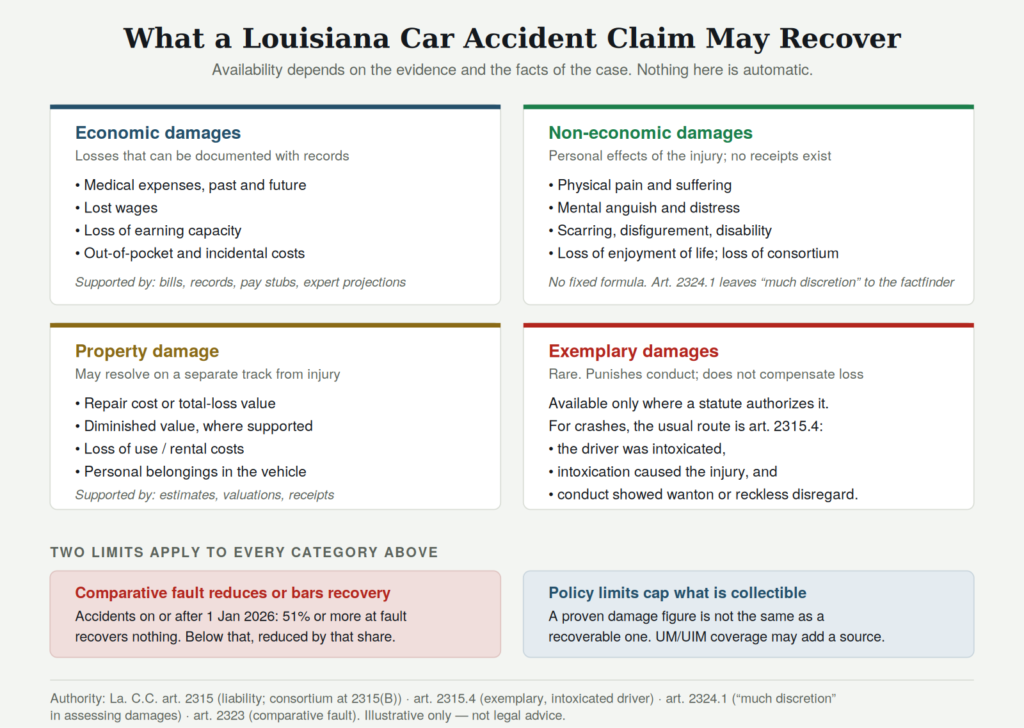
Louisiana car accident claims may include economic damages, non-economic damages, property losses, and, in limited circumstances, exemplary damages. The amount available depends on the evidence, the severity of your injuries, the applicable insurance coverage, and each party’s percentage of fault.
Every accident affects people differently. You may be facing pain, medical appointments, missed work, vehicle problems, and uncertainty about what to do next. A claim should be evaluated based on the evidence of your actual losses, not a one-size-fits-all formula. Careful documentation and legal guidance from a local car accident lawyer in Slidell, LA can help protect your rights and prevent important accident damages from being overlooked.
Economic Damages for Medical Bills and Lost Income
Economic damages compensate you for financial losses that can usually be supported with bills, receipts, employment records, or professional estimates. They may include expenses already incurred and losses reasonably expected in the future.
Medical expenses are often a major part of a personal injury case. Depending on your injuries and treatment plan, recoverable costs may include:
- Ambulance transportation and emergency room care
- Hospital stays, surgery, and diagnostic testing
- Appointments with physicians and specialists
- Physical therapy and rehabilitation
- Prescription medications and medical equipment
- Counseling or psychological treatment
- In-home assistance or nursing care
- Future medical bills connected to the accident
Prompt medical attention protects your health and creates records showing when symptoms began, which injuries were diagnosed, and what treatment was recommended. A delay may give an insurance company room to argue that an injury was minor, unrelated to the crash, or worsened because treatment was not sought promptly.
Future medical costs also require attention. A spinal injury, traumatic brain injury, serious fracture, or lasting nerve damage may require additional procedures, therapy, medications, or supportive care. Medical opinions and cost projections can help document these needs before the claim is resolved.
Accepting a settlement usually closes the claim, which may prevent you from seeking additional compensation if treatment later costs more than expected. Before agreeing to a settlement, it is important to understand your diagnosis, likely recovery timeline, and future medical needs.
Lost wages may be recovered when injuries prevent you from working. Pay stubs, tax returns, attendance records, and employer statements can help establish lost income. Self-employed workers may use business records, invoices, contracts, or prior earnings information.
A severe injury may also reduce future earning capacity. This differs from ordinary wage loss because it addresses how an injury affects your ability to earn income over time, even if you eventually return to work. Relevant factors may include age, occupation, training, education, physical restrictions, and expected career progression.
Medical bills, property damage, lost income, and reduced earning capacity may all form part of a Louisiana car accident claim. Lavis Law Firm can help identify and document these losses so you understand the compensation that may be available.
Property Damage and Other Accident-Related Costs
Property damage claims commonly focus on the vehicle, but other accident-related losses may also be recoverable. Your car may require repairs, be declared a total loss, or lose market value after repairs. Personal belongings inside the vehicle may also be damaged.
| Type of loss | Examples | Helpful evidence |
|---|---|---|
| Vehicle repairs | Parts, labor, paint, frame repair, mechanical repairs | Photographs, repair estimates, invoices, inspection reports |
| Total loss | Fair market value of a vehicle that cannot be economically repaired | Valuation reports, maintenance records, comparable vehicle listings |
| Loss of use | Rental-car costs or reasonable transportation expenses | Rental agreements, rideshare receipts, transportation logs |
| Diminished value | Reduced resale value after significant repairs. It may be recoverable from an at-fault driver when supported by evidence. Coverage under your own collision policy may depend on the policy language. | Appraisal reports, repair history, market comparisons |
| Personal property | Phones, laptops, tools, child safety seats, clothing, or equipment | Receipts, photographs, purchase records |
| Incidental expenses | Towing, storage, treatment-related travel, or necessary household help | Receipts, invoices, mileage records |
A total-loss offer deserves careful review because insurance valuation systems may not reflect your vehicle’s condition, mileage, upgrades, maintenance history, or local market. Pre-accident photographs, service records, and comparable listings may support a more accurate value. An attorney can help evaluate whether a valuation is supported by the vehicle’s documented condition and whether the dispute involves the at-fault driver’s insurer, your own policy, or both.
Loss-of-use claims may cover reasonable rental-car or transportation expenses while a vehicle is repaired. When a vehicle is a total loss, the recoverable period generally depends on the reasonable time needed to evaluate the loss, receive available claim funds, and obtain a replacement vehicle.
Photographing damaged belongings, preserving them when practical, and collecting proof of value can help show what was lost. Child safety seats may need replacement after certain collisions even if damage is not visible. Work tools, mobility devices, electronics, and other belongings may also add to a property claim.
Property damage and bodily injury claims may move on different schedules. Resolving the vehicle portion does not necessarily require settling the personal injury claim. Before signing a release, make sure you understand which claims it covers.
Non-Economic Damages for Pain and Suffering
Not every accident loss has a receipt. Non-economic damages address the personal effects of an injury, including physical pain, emotional distress, disability, scarring, and reduced enjoyment of life.
Pain and suffering may include immediate discomfort and recurring or permanent symptoms. Headaches, limited mobility, disrupted sleep, weakness, numbness, and chronic pain can affect work, parenting, recreation, relationships, and household tasks. The duration and intensity of these symptoms often influence how damages are evaluated.
An accident can also cause real and disruptive emotional effects. You may experience anxiety while driving, nightmares, depression, irritability, embarrassment, or fear of another collision. Some injuries affect appearance, independence, relationships, or participation in activities that once brought enjoyment.
Louisiana personal injury damages may include general damages for physical pain, mental distress, scarring, disfigurement, and loss of enjoyment of life. A spouse, child, or parent may also have a loss-of-consortium claim when an injury causes a real loss of companionship, affection, household services, aid and assistance, or other aspects of the relationship. These damages are not automatic; the family member must show a personal loss caused by the injury.
There is no universal calculator for non-economic damages. Insurance companies may use internal formulas, but those formulas do not define the value of your experience. Factors that may affect the assessment include:
- The type and severity of the injuries
- The length and difficulty of medical treatment
- Whether symptoms are temporary or permanent
- The effect on work and daily responsibilities
- Limitations on hobbies, travel, exercise, or family activities
- Visible scarring, disfigurement, or reduced mobility
- Clear and consistent medical and personal documentation
A daily journal may help document symptoms, medication use, sleep problems, missed family events, and activities that have become difficult. Statements from relatives, friends, or coworkers may also show changes that medical bills cannot capture.
Exemplary Damages in Limited Louisiana Car Accident Cases
Compensatory damages address your losses. Exemplary damages—sometimes called punitive damages—serve a different purpose. They are designed to punish certain conduct and discourage similar behavior.
Exemplary damages are not available simply because a driver was careless, speeding, distracted, or responsible for a serious collision. Louisiana generally permits them only when a specific law authorizes them.
One situation involves an intoxicated driver. Under Louisiana Civil Code article 2315.4, exemplary damages may be available when an intoxicated driver’s conduct showed wanton or reckless disregard for the rights and safety of others.
To recover exemplary damages, the evidence must establish that the driver was intoxicated while operating a motor vehicle, that the intoxication was a cause in fact of the resulting injuries, and that the injuries were caused by wanton or reckless disregard for the safety of others.
Evidence relevant to this type of claim may include:
- Police observations and field-sobriety testing
- Breath, blood, or urine test results
- Bar, restaurant, or purchase records
- Witness statements
- Video footage
- Admissions by the driver
- Other admissible evidence relevant to intoxication, impairment, causation, or reckless disregard
The presence of alcohol or drugs does not automatically establish an exemplary-damages claim. The evidence must satisfy the legal requirements and connect the intoxicated driving to the accident and injuries.
Insurance coverage for exemplary damages can also raise legal and policy questions. An attorney may need to evaluate the driver’s assets, available policies, and all potentially liable parties before deciding how to pursue the claim.
How Fault and Insurance Affect Recoverable Damages
Proving your losses is only part of a car accident case. You may also need to establish who caused the collision and identify the insurance coverage or other assets available to pay a claim.
Effective January 1, 2026, Louisiana Civil Code article 2323 generally bars recovery when an injured person is assigned 51 percent or more fault. Claims arising from accidents before the law took effect may be governed by Louisiana’s former pure-comparative-fault rule, so the accident date remains important. Louisiana Civil Code article 2323
Under the law effective January 1, 2026, a person assigned less than 51 percent fault may recover damages, but the recovery is reduced by that person’s percentage of responsibility. For example, a person with $100,000 in proven damages who is found 20 percent responsible may recover $80,000 before insurance limits and other issues are considered. A person assigned 51 percent or more fault generally cannot recover damages.
Fault disputes may involve traffic citations, witness testimony, vehicle positions, photographs, surveillance footage, electronic data, and accident reconstruction. Statements made shortly after the collision may also affect the claim.
When speaking with an insurance adjuster, provide accurate facts, but avoid guessing about speed, distance, injuries, or responsibility. Early statements may later be compared with medical records or other evidence. A lawyer can communicate with the insurer and help you avoid statements that could be taken out of context.
Available compensation may also depend on the insurance coverage that applies. Potential sources can include:
- The at-fault driver’s bodily-injury liability coverage
- The vehicle owner’s policy
- An employer’s policy when the driver was working
- Uninsured or underinsured motorist coverage
- Medical payments coverage
- Commercial or rideshare insurance
- Other parties whose conduct contributed to the accident
Some collisions involve several responsible parties. A trucking company, vehicle manufacturer, maintenance provider, employer, or government entity may share liability depending on how the crash occurred. Identifying every responsible party can be important when the injuries exceed one driver’s policy limits.
Settlement value depends on the evidence, degree of fault, available coverage, medical prognosis, and effect of the injuries. A reliable estimate requires a review of the specific facts rather than assumptions based only on medical bills.
Building a Claim That Reflects the Full Damage
You should not have to manage an accident claim alone while dealing with medical care, missed work, and family responsibilities. Preserving evidence and keeping consistent records can help protect your claim, and a legal team can assist with gathering and organizing the required information.
Photographs of the scene, vehicle damage, and visible injuries should be preserved. Attend medical appointments and follow treatment instructions when reasonably possible. Keep bills, wage records, repair estimates, receipts, and insurance correspondence together for easier review.
An insurance company may request a recorded statement, broad medical authorization, or signed release before the full medical outlook is understood. Accepting payment and signing a release may end your right to seek further compensation even if symptoms worsen. Having an offer and release reviewed before signing can help you understand which rights you may be giving up.
A car accident lawyer can investigate liability, identify coverage, collect medical and employment evidence, assess economic and non-economic damages, communicate with adjusters, and prepare the case for trial when a reasonable settlement is not offered. Lavis Law Firm also keeps clients informed and explains each stage of the process so they can focus on recovery and make informed decisions.
Lavis Law Firm represents people injured in Louisiana car accidents, offers free case evaluations and video consultations, and handles accepted car accident cases on a contingency-fee basis. Attorney fees are not owed unless the firm obtains a recovery.
During a consultation, the firm can listen to your concerns, review how the accident affected you and your family, identify possible compensation sources, and explain the claim’s strengths and risks. The review may also determine whether fault is disputed, whether other parties may be responsible, and what evidence is needed.
Contact Lavis Law Firm to discuss your accident and legal options. The firm can help you understand the available coverage, develop a strategy suited to your circumstances, and decide what steps to take next in seeking compensation for your physical, financial, and personal losses.
This post is general information about legal developments, not legal advice. It may discuss court decisions, statutes, or regulations without describing every fact, issue, or exception that could apply, and state and federal law changes over time. No representation is made that this post is accurate, complete, or current, either now or at the time it was published. Reading it does not create an attorney-client relationship. See our full Disclaimer, and contact our office to discuss your specific situation.