

After a collision, medical care, vehicle repairs, missed work, and insurance calls can disrupt daily life. As these pressures build, many injured people ask: How long does a car accident claim take?
There is no fixed timeline. A straightforward property-damage claim may be resolved within weeks, while a personal-injury claim involving ongoing treatment, disputed fault, or significant losses may take months or longer. If a lawsuit becomes necessary, the case may extend beyond a year.
The duration depends on how quickly evidence is collected, when your medical condition becomes clear, whether the insurance company accepts liability, and how both sides respond. Accepting an early settlement before the full impact of an injury is known could leave you responsible for future costs.
Understanding the stages can help you set realistic expectations and evaluate an offer. Lavis Law Firm can provide guidance after a collision, communicate with the insurer, and help you make informed decisions while you recover. If you were hurt in a crash in St. Tammany Parish, a car accident lawyer in Slidell, LA can review your claim.
The Typical Stages of Car Accident Claims
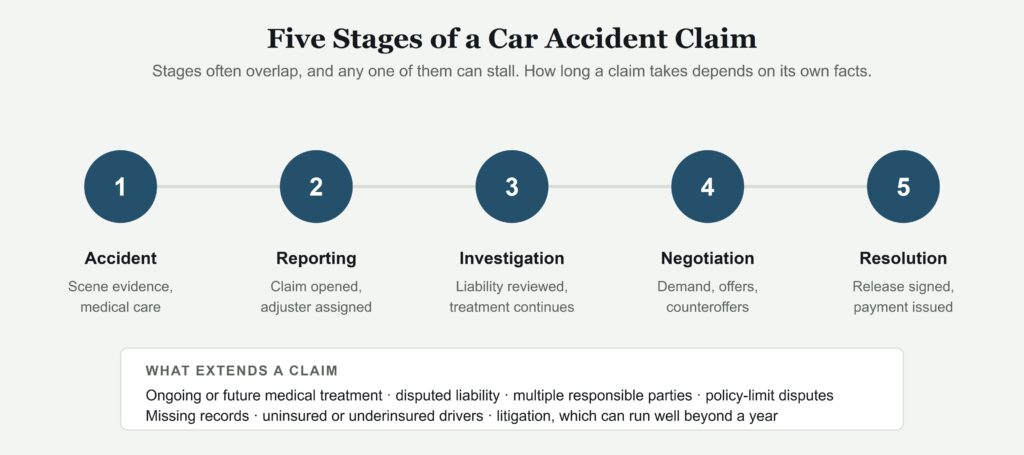
A car accident claim moves through several connected stages. Some may overlap, but careful preparation can support a fair resolution.
The process begins when the accident is reported to the insurance companies. The insurer opens a file, assigns an adjuster, and reviews the collision. The adjuster may request:
- The police accident report
- Photographs or video from the scene
- Statements from drivers and witnesses
- Vehicle repair estimates
- Medical records and bills
- Proof of lost income
- Information about prior injuries
An insurance adjuster may make contact within days, but timing varies. Reporting delays, missing information, or unavailable witnesses can slow the investigation.
When a car accident causes injuries, the personal-injury claim often cannot be fully valued until your condition and future medical needs are understood. Doctors may need time to diagnose the injury, assess your response to treatment, and determine whether further care is needed.
Settling while treatment is underway may create problems. Once you sign a settlement agreement and release, you generally cannot seek additional compensation from the released parties for claims covered by that agreement—even if symptoms worsen or further treatment becomes necessary.
This does not mean you must wait until you have completely recovered. In serious personal-injury cases, an attorney may work with medical providers to estimate future care, disability, and related losses.
Once evidence is collected and damages can be calculated, you or your lawyer may send a settlement demand. It usually explains how the accident occurred, why the other party is responsible, what injuries resulted, and what compensation is requested.
The insurance company may accept the demand, reject it, or make a counteroffer. If both sides agree, settlement documents are prepared and signed before payment is issued.
A lawsuit may be considered when the insurer denies responsibility, disputes the injuries, undervalues the losses, or refuses to negotiate reasonably. Filing suit does not mean the case will go to trial. Many car accident cases settle during discovery, depositions, motions, or mediation.
Court schedules and deadlines usually make litigated claims take longer than negotiated claims.
What Happens at Each Stage of the Settlement Process
No timeline applies to every case. A claim can stall at any stage, and the stages often overlap. What follows is what each stage involves and what commonly slows it down — not how long it should take.
| Stage | What Usually Happens | What Can Extend It |
|---|---|---|
| Claim opening | The accident is reported and an adjuster is assigned. | Reporting delays, missing information, or witnesses who cannot be reached |
| Liability investigation | Reports, statements, photographs, and insurance coverage are reviewed. | Conflicting accounts, several vehicles, disputed fault, or evidence that must be subpoenaed |
| Medical treatment | Injuries are diagnosed, treated, and monitored. | Ongoing care, symptoms that appear later, treatment gaps, or an uncertain prognosis |
| Damage evaluation | Medical costs, income loss, property damage, and other losses are calculated. | Future care projections, expert opinions, or incomplete wage records |
| Settlement negotiations | Demands, offers, counteroffers, and supporting documents are exchanged. | Disputes over value, limited policy limits, or several claimants competing for the same coverage |
| Payment after settlement | Releases, lien or reimbursement issues, and payment documents are processed. In certain cases, Louisiana law requires an insurer to timely pay amounts due under a written settlement of a bona fide third-party property-damage or reasonable-medical-expense claim. | Unresolved medical liens, health-plan reimbursement claims, or multiple payees |
| Lawsuit and litigation | Pleadings, discovery, depositions, mediation, and possible trial occur. | Court schedules, discovery disputes, expert scheduling, or an appeal |
A minor car accident involving clear fault, limited treatment, and adequate insurance coverage may resolve quickly. Other claims may take months because treatment continues, records are incomplete, or the insurer disputes the claim.
Serious personal-injury cases may require expert opinions, accident reconstruction, employment records, future medical projections, or testimony about long-term limitations. These steps help document how the accident affected your health, income, activities, and future needs.
Agreeing to a settlement and receiving the funds are separate steps. After both sides agree, releases may need to be signed and liens or other reimbursement issues may need to be addressed. In certain cases, Louisiana law requires an insurer to timely pay amounts due under a written settlement of a bona fide third-party property-damage or reasonable-medical-expense claim, and an unjustified failure to comply may support statutory penalties and attorney fees. La. R.S. 22:1892
Factors That Can Change a Car Accident Settlement Timeline
The duration of a claim often depends on disputed issues rather than vehicle damage. A seemingly simple car accident may still produce a dispute over fault or injury causation.
When one driver clearly violated a traffic rule and reliable evidence supports it, the liability decision may be direct. The process can take longer when drivers provide conflicting accounts, witnesses disagree, or several vehicles were involved.
Photos, witness statements, police reports, and other records may help establish how fault is proven after a car accident.
Louisiana now follows a modified comparative fault system. For accidents on or after January 1, 2026, a person assigned 51% or more of the fault generally recovers nothing; below that, recovery is reduced by their percentage of fault. Accidents before that date generally remain under the former pure comparative fault rule, which reduced recovery by the plaintiff’s share without a percentage bar. Because fault percentages can decide whether there is any recovery at all, insurance companies may investigate them closely.
The nature and duration of the injuries can also affect the timeline. Soft-tissue injuries, fractures, head injuries, spinal injuries, and aggravated preexisting conditions follow different recovery paths. Some symptoms develop after the accident.
The insurer may wait for records or question whether treatment is related to the collision. Gaps in care, missed appointments, or inconsistent histories may lead to further review of the personal-injury claim.
Serious injuries may require evidence concerning:
- Future medical procedures and rehabilitation
- Reduced earning capacity
- Permanent impairment or disability
- Household assistance
- Pain, suffering, and emotional distress
- Changes in daily activities
A case involving future losses generally requires deeper analysis than one involving brief treatment.
Insurance coverage and policy limits may create additional delays. The insurer may investigate whether the policy was active, whether the driver had permission to use the vehicle, whether an exclusion applies, or whether another insurance policy should contribute.
Complications can arise when the responsible driver is uninsured or underinsured. Your own insurance policy may provide coverage, but the insurer may still investigate liability and damages.
When several injured people seek compensation from a limited policy, negotiations may take longer because the available insurance funds must be divided among competing claims.
The quality of the evidence also influences how efficiently the insurer can evaluate the case. Missing records, unclear photographs, unavailable witnesses, or incomplete wage documents may lead to repeated requests.
Evidence can disappear. Surveillance footage may be overwritten, vehicles repaired, and memories may fade. Early investigation can preserve information that later becomes difficult to obtain.
Insurance companies do not move at the same pace. An adjuster may have a large caseload, request documents in stages, or need time to obtain settlement authority.
Some delays arise from routine investigation or genuine disputes about liability, treatment, damages, or coverage. In other situations, an insurer’s conduct may warrant closer review under Louisiana’s claims-handling laws. A lawyer can track communications, provide missing materials, request explanations, and address unsupported positions.
Steps That May Help Keep a Car Insurance Claim Moving
You cannot control every part of the process, but careful action can reduce delays. Managing records may be difficult while dealing with pain, appointments, work disruption, and family responsibilities. A personal-injury lawyer can help organize and present evidence.
Seek medical care and follow the treatment plan. Delaying evaluation may affect your health and the connection between the injury and the car accident. Describe symptoms accurately and attend recommended appointments.
Report the collision promptly, but use care when speaking with an opposing insurance company. Adjusters may request a recorded statement or broad access to medical records. Consider speaking with a lawyer before agreeing.
The following practices can help maintain an organized record:
- Preserve accident evidence. Save photographs, video, witness information, police reports, repair estimates, and damaged personal items.
- Track medical care. Keep records of appointments, prescriptions, mileage, out-of-pocket expenses, and changes in symptoms.
- Document income loss. Retain pay stubs, employer letters, tax records, and information about missed work or reduced duties.
- Save all insurance correspondence. Keep letters, emails, claim numbers, adjuster names, and notes from telephone conversations.
- Respond to reasonable requests promptly. Delayed records or unanswered questions may prevent the adjuster from completing the evaluation.
- Avoid discussing the accident on social media. Posts, photographs, comments, and activity updates may be used to challenge the injury claim.
- Do not accept an offer without reviewing its scope. An early payment may require a release of all claims, including losses that have not yet become apparent.
Statements to medical providers, insurers, employers, and attorneys should be truthful and consistent. Guessing about speed, symptoms, or prior treatment can create discrepancies that affect the case.
It is also important to act before Louisiana’s filing deadline expires. For many car-accident injury claims arising on or after July 1, 2024, Louisiana generally provides a two-year period to file suit, measured from the date injury or damage is sustained. Different rules or transition issues may apply, including to accidents that occurred earlier or claims involving particular defendants. An insurance investigation or settlement discussion does not automatically preserve the right to sue, so it is important to obtain timely legal advice. La. C.C. art. 3493.1
How a Personal Injury Lawyer Can Help With a Car Accident Claim
Legal representation cannot promise a timeline, but an attorney can identify delays, keep the claim moving, and protect your interests. Your lawyer may advise against settling before the injuries and losses are documented.
A personal-injury lawyer can investigate the collision, identify responsible parties, collect records, communicate with insurance companies, evaluate damages, and negotiate for you. When needed, the attorney can file a lawsuit and prepare the case for mediation or trial.
Lavis Law Firm represents people injured in car accidents in New Orleans and communities throughout Louisiana. The firm assists with medical bills, lost wages, loss of earning capacity, property damage, and pain and suffering. Lavis Law also communicates with insurers and works to establish liability.
Charles Lavis has practiced law since 1995, bringing decades of experience to personal-injury and insurance matters. The firm emphasizes direct communication, individualized attention, strategic preparation, and clear explanations.
The appropriate approach balances progress with preparation. Speed should not come at the cost of overlooking future care or accepting an amount that does not reflect documented losses.
Speak With Lavis Law About Your Claim Timeline
When a claim remains unresolved, it can be difficult to know whether the delay is normal or action is needed. Lavis Law can review the accident, insurance coverage, treatment, negotiations, and Louisiana deadlines to help you understand where the case stands.
Lavis Law Firm offers free case evaluations and handles personal-injury matters on a contingency-fee basis, so clients do not owe attorney fees unless the firm secures a successful outcome. Court costs and case expenses may be the client’s responsibility, depending on the fee agreement.
Contact Lavis Law for a free consultation about your car accident and claim. The firm can listen to your concerns, explain the options clearly, and help determine the next steps toward a fair resolution.
This post is general information about legal developments, not legal advice. It may discuss court decisions, statutes, or regulations without describing every fact, issue, or exception that could apply, and state and federal law changes over time. No representation is made that this post is accurate, complete, or current, either now or at the time it was published. Reading it does not create an attorney-client relationship. See our full Disclaimer, and contact our office to discuss your specific situation.